
Vertical farming has spent a decade being pitched as agriculture's answer to almost everything. For industrial bakeries, the honest answer is narrower: it is not going to grow your wheat, but it may well grow what sits on top of it.
The flour question, settled early
Start with the crop that matters most to bakers. Wheat, rye and barley are dry matter, low value per kilogram crops, and vertical farming's economics run the wrong way for exactly that profile. A recent analysis in Plant Physiology put the current minimum production cost for dried staple crops through vertical farming at around $10 per kilogram of dry plant matter, against less than $1 per kilogram through conventional field production - an order of magnitude more expensive than current production, based on the expected upper-bound energetic efficiency of vertical farming in the near future [1]. The same paper found more marginal competitiveness for high-value, low dry matter crops such as lettuce and tomatoes, where vertical farming's minimum cost lands close to conventional pricing, at roughly $0.5 per kilogram for both [1]. For flour millers and bakers, that gap is not closing soon. Wheat stays a field crop.
Where vertical farms do fit a bakery's supply chain
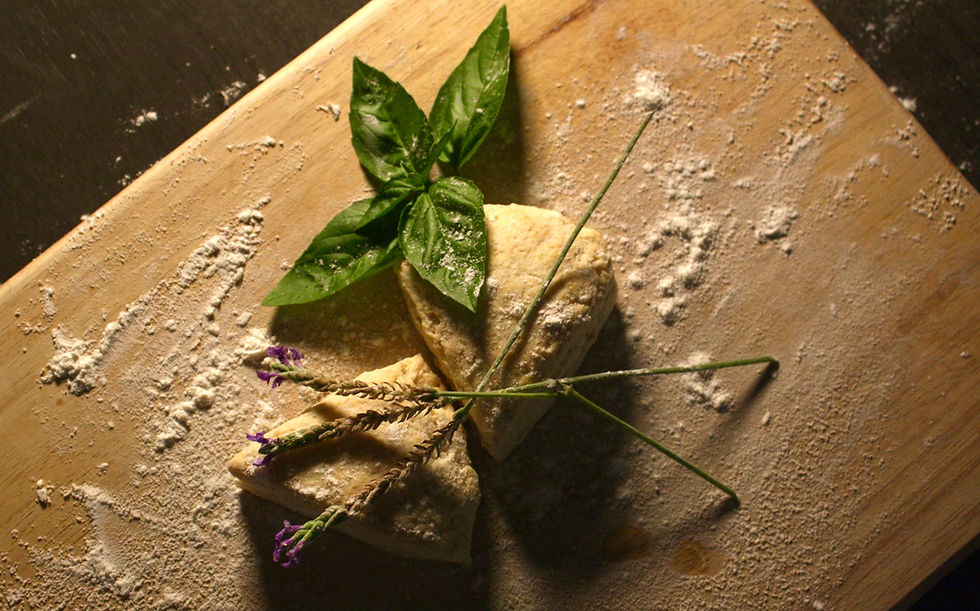
The overlap sits in the high-value, fast-turnover ingredients that sit alongside the loaf rather than inside it. Vertical farm operators already supply food service with herbs, microgreens and edible flowers on tight delivery cycles, positioning that produce for its freshness and consistency rather than its cost per kilo. Fresh Origins in California now grows over 600 varieties of microgreens, herbs and flowers for chefs and culinary professionals, and similar specialist growers (Greeneration in Dubai, Farm.One in New York) have built entire businesses around gourmet garnish crops rather than commodity greens. For bakeries producing focaccia, savoury pastries or filled goods with a premium positioning, that is a plausible sourcing line: rosemary and thyme for bread, microgreens for sandwich lines, edible flowers for cake decoration. It will not replace a conventional herb supplier on cost but it may replace one on consistency and shelf life.
The energy problem nobody in the sector is glossing over
The industry's own commentary in 2026 has become considerably more sober about running costs. A 2026 energy report tracking real data from operators including Plenty, AeroFarms and Bowery put legacy vertical farms at 40 to 120 kWh per kilogram of lettuce produced, with best-in-class 2026 facilities achieving 11 to 15 kWh per kilogram. This is still a meaningful load against greenhouse alternatives, and grid rates above $0.12 per kWh are described as making a project "uninvestable" [2]. Comparative studies are consistent on the direction of travel even where the multiple varies: one life cycle assessment found vertical farms consume 2.5 times more energy than greenhouses due to lighting, while cutting water and CO2 use by 50 and 1.8 times respectively. An older Agritecture review put the gap wider still, at 38.8 kWh per kilogram for vertical farms against 5.4 kWh per kilogram for traditional greenhouses [3]. In the UK specifically, standing charges for high-capacity grid connections are set to rise by roughly 94% from April 2026 for some users, and vertical farming does not currently qualify for the exemption scheme available to other energy-intensive industries [4]. Any bakery evaluating a vertical farm as a supplier partner, or considering co-location, should treat that instability as a live commercial risk, not a footnote.
The hybrid model gaining ground
What is shifting is the framing. Operators increasingly describe vertical farming as demand-led rather than volume-led production. Planet Farms, founded in Milan in 2018, has built its model around growing what is needed close to where it is consumed rather than scaling horizontally by land area. It describes its approach explicitly as demand-driven agriculture, treating food production like an engineering process rather than something dependent on land, climate or seasonality [5]. A separate industry review of the sector's 2026 direction reached a similar conclusion from the operator side: the most durable vertical farms are validating every expansion decision against demand data and cash flow rather than investor enthusiasm, with sales channel built before production capacity rather than after [2]. That discipline maps reasonably well onto a bakery's own supply logic: garnish and speciality crops ordered against confirmed volume, not stockpiled against forecast.

The renewable energy question is not incidental
Where vertical farms are managing to make the economics work, on-site or contracted renewable generation is doing most of the heavy lifting. The same 2026 energy analysis found utility-scale solar now costing $0.03 to $0.05 per kWh, against grid commercial rates of $0.12 to $0.20 per kWh, with farms achieving 50% or more renewable self-consumption effectively hedging against the price volatility that has driven several high-profile commercial failures [2]. For bakeries with existing waste heat streams from ovens, or renewable infrastructure already in place, that opens a genuine conversation about shared utilities with a co-located grower, rather than a straightforward supplier relationship.
What this means for the congress
Our parent group FoodBev Media's forthcoming congress puts most of this directly on the agenda: energy economics and investment appetite in the morning sessions, demand-led strategy and retail positioning through the midday programme and hybrid vertical-plus-greenhouse models in the afternoon, including Karl-Martin Viken's session on combining 16 days of vertical growth with 14 in the greenhouse. For anyone weighing a vertical farm relationship for garnish or speciality ingredients, rather than flour, the sessions on strategic choices and sustainability measurement will likely be the most directly useful.
To register your interest in the conference, visit: https://www.foodbevevents.com/registration/vertical-farming-world-congress-2026
References
Vertical farming limitations and potential demonstrated by back-of-the-envelope calculations, Plant Physiology. https://academic.oup.com/plphys/article/198/3/kiaf056/8104144
Vertical Farming Energy 2026: The Race for Grid Parity. https://energy-solutions.co/articles/sub/vertical-farming-energy-optimization-market-intelligence-2027
Vertical Farms Have The Vision, But Do They Have The Energy?, Agritecture. https://www.agritecture.com/blog/2022/6/10/vertical-farms-have-the-vision-but-do-they-have-the-energy
UK growers face multi-million-pound annual energy cost surge, Hortidaily. https://www.hortidaily.com/article/9802505/
Speaking on the intersection between AI and growing, Vertical Farm Daily. https://www.verticalfarmdaily.com/article/9831989/

_gif.gif)
